Tourism Places In nagaurnagaur Fort 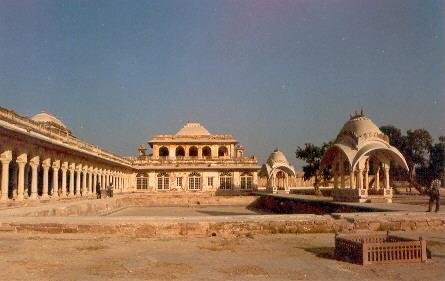 At one end of the Thar desert lies the picturesque town of nagaur. Located 137km to the north of Jodhpur, the nagaur fort shimmers like a beacon in sharp contrast to the dull sandy stretch of desert which surrounds it. Located atop a hill like so many of Rajasthan's forts for strategic reasons is the historic nagaur fort, dating back to the 4th century. The city itself has three main entrances called the Delhi Gate, the Tripolia Gate, and the Nakash Gate. The three palaces within the fort which are particularly exquisite are the Hadi Rani Mahal, the Sheesh Mahal and the Badal Mahal which are noted for their beautiful frescoes. Nearby lies a mosque which was built by the Mughal emperor Akbar and a shrine dedicated to a follower of Moin-uddin Chishti, the famous sufi (mystic) saint who lived in nearby Ajmer. Also in Nagore lie a cluster of cenotaphs built in the traditional Rajput style like pristine stone umbrellas.
Bhakt Singh Palace Also worth looking out for is the Bhakt Singh Palace although the history behind it is particularly gory. Bhakt Singh was the ruler of nagaur in the first half of the 18th century. His brother Abhay Singh was the heir apparent to the throne of Jodhpur and was persuaded by the Mughals to become the ruler by murdering his own father. Abhay Singh assigned this task to his brother Bhakt, promising him nagaur if he commited the foul deed. Bhakt willingly commited the patricide and became the ruler of nagaur and built a splendid palace for himself inside the ancient fort. Hadi Rani Mahal 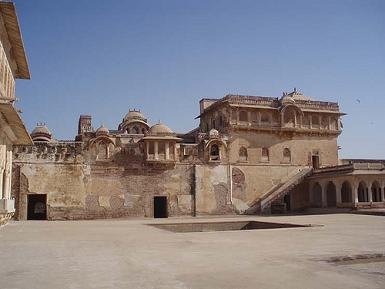 Although the fort is in a fairly dilapidated state it does house some beautiful palaces. One of the most beautifully decorated palaces is the Hadi Rani Mahal which has intricately carved designs all over its walls and ceilings. It is further embellished by exquisite mural paintings mostly displaying Maharani Hadi Rani (one of the most well known maharanis of nagaur) along with her retinue. It also has a particularly fascinating frescoed ceiling which is worth travelling miles to see.
Deepak Mahal The other palace to look out for is the Deepak Mahal which is decorated with beautiful floral designs from wall to wall. In rain parched nagaur the temple is like a breath of fresh air, and it is natural that the desert fiefdom, deprived of any greenery, painted pictures of beautiful flowers and shrubs. Deepak Mahal represents a fantasy for the people of nagaur. Tarkeen Dargah 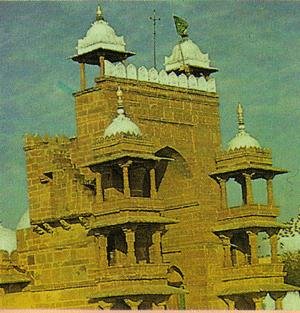 Most renowned after the Ajmer Dargah sacred place for Muslims & Sufis.
Jain Temple in Glass - Lofty structure of glass sacred place for the Jain community.
Saiji ka Tanka - Samadhi of a renowned saint, inspires the liberation of the soul with simplicity & truthfulness a symbol of communal harmony.
Most renowned after the Ajmer Dargah sacred place for Muslims & Sufis.
Jain Temple in Glass - Lofty structure of glass sacred place for the Jain community.
Saiji ka Tanka - Samadhi of a renowned saint, inspires the liberation of the soul with simplicity & truthfulness a symbol of communal harmony.
Mosques The fortress houses the Shah Jahani Mosque, which was built by the Mughal emperor Shah Jahan during the time when nagaur was under Mughal control. In a decrepit state the mosque is no Taj Mahal but an important historical monument nonetheless. It represents the time when the Mughals enjoyed uninterrupted power in nagaur from the time Akbar conquered it in 1556 to when his grandson Shah Jahan voluntarily bestowed it to Amar Singh in 1638. A few kilometers away from the fort is the Akbari Masjid constructed by the Mughal emperor himself in the 16th century. The monument has stood the test of time with the interiors still quite well preserved although the facade is in a shabby condition. The inner part is lined with blue tiles and all the inscriptions inside are intact. The mosque serves a dual purpose as it is used as a madarsa (school) in the morning where local children assemble for their lessons. However, the main mosque in nagaur as in virtually every town and city in India is the Jama Masjid. Located a short distance away from Ahhichatragarh fort the Masjid is an impressive monument, and has four huge minarets which are almost as high as a skyscraper. The monument has become a little worse for wear over the years. Jama is a corruption of Jumma, which means Friday and is the Muslim holy day. Therefore, Friday prayers are held in the main mosque across the country. Shah Jahani Masjid This masjid within the fortress was built by the Mughal Emperor Shah Jahan during the time when nagaur was under the Mughal control. In a frail state the mosque is no Taj Mahal but was definately an important historical monument. In a way, it represents the time when the Mughals enjoyed uninterruped power in nagaur from the time Akbar conquered it in 1556 to when his grandson Shah Jahan voluntarily bestowed it to Amar Singh in 1638. Khinvsar 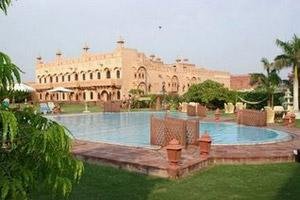 Khinvsar Fort - Situated 42 km away from nagaur on the National Highway No. 65 towards Jodhpur 500 years old fort in the middle of the Thar Desert turned into a hotel furnished with modern facilities. Mugal Emperor Aurangzeb used to stay here Khinvsar town has 25 small temples black deer roaming in herds are a very popular tourist attraction.
Jayal Dadhimati Temple - Also known as Goth-Manglod temple 40 km away from nagaur the oldest temple of the district constructed during the Gupta Dynasty (4th Century) Kul Devi of Dadhich Brahimins. Merta Meera Bai Temple Also known as the Charbhuja temple 400 years old evidences how total surrender helps attain godly qualities how deep faith converts poison to 'Amrit'. Bhanwal Matta Temple - 25 km away from Merta City carries a very interesting story that when thieves were found to be under threat of life they remembered mother by heart mother appeared for their rescue temple was got constructed under obligation the thieves who escaped vowed never to commit theft again mother takes two a half cups of wine from a true seeker. Kuchaman City 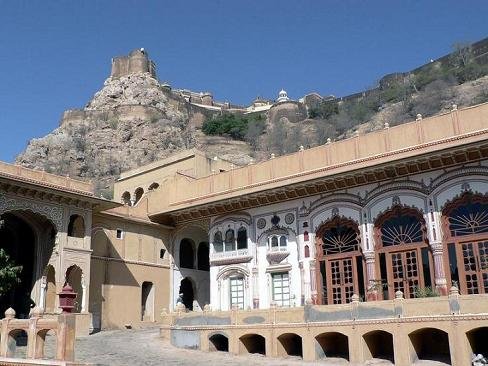 Kuchaman Fort - One of the oldest & most inaccessible forts of Rajasthan situated on top of a straight hill unique water harvesting system Jodhpur rulers used to mint their gold & silver currency here affords a beautiful view of the city fort converted into a hotel has a strong attraction for tourists.
Makarana Makarana - A treasure trove of marble examplifies how stones can be shaped & made use of marble mining is the main-stay of living for the locals worth seeing how stone brings quality in life this marble used in the construction of the Taj Mahal, Victoria Memorial & other buildings in white stone. Ladnun Jain Vishva Bharti Institute (deemed University) - A famous centre of Jainism a school of thought a centre of spirituality & purification a society of Ahinsa a treasure of tranquility an abode of humanity on earth. Amar Singh Mahal (Palace) 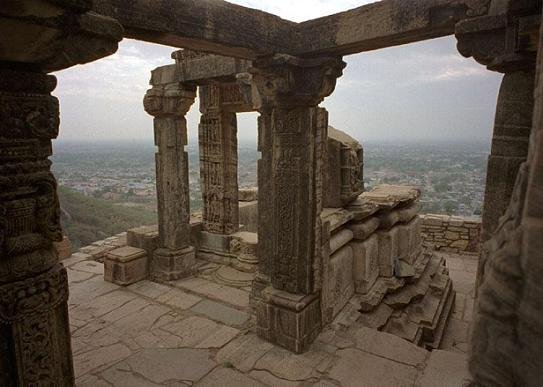 The fort also houses the Amar Singh Mahal, which is decorated from floor to ceiling with intricately carved designs. Amar Singh was the ruler of nagaur during the Mughal emperor Shah Jahan's reign to avenge the death of a Mughal courtier called Salabat Khan. The palace is a fitting tribute to his memory. Although he was cremated on the banks of the Yamuna, his wives commited sati (self-immolation) in nagaur itself, and their palm impressions can be found nearby.
Akbari Mahal Nearby lies the Akbari Mahal, which was built to commemorate the recapture of nagaur by the Mughals from the governor of Ajmer in 1556. The art and architecture of the palace clearly indicates a confluence of both Rajput and Mughal art. In fact, the Mughal style and influence can be seen in most of the airy palaces and pavilions. Rani Mahal Also to be found in the fort is the Rani Mahal and the Zenana Deori. The Rani Mahal was obviously the dwelling place of the wives of the rulers of nagaur as was the Zenana Deori. The Zenana Deori has paintings on its ceilings rather similar to the Sistine Chapel in Rome. They must have had a local Michaelangelo in their midst in medieval nagaur. Also in the women's quarters is the Baradari, which is another residence where the royal ladies lived. It also contains a small swimming pool. In one of the palaces is also housed an ornate hammam or bath. Magnificent Fort Gateways As seen, the gateways to a fort in Rajasthan are no diminutive ones - as they were massive stone structures with reinforced doors to ward off elephants and even cannon shots. Mostly, there are notched parapets at the top of the gates from where archers could shoot at their tormentors. 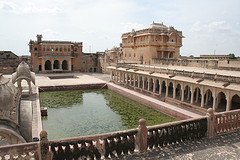 The nagaur Fort Had Three Main Gates
Sireh Pol : The outermost gate has heavy wooden doors fitted with iron spikes to prevent elephant charge. Beech Ka Pol : This is the second gate of the impressive fort. Kacheri Pol : The last gate is known so because it housed the judiciary of nagaur in ancient times. Other Places of Interest Maroth - Situated in Nawan tehsil of nagaur District. 11 kms away from Nawan & 11 kms away from the Kuchaman Road railway station. Harsor - Situated in Degana tehsil of nagaur district. About 30 kms from Degana. Phalvardhika - Situated in Merta tehsil of nagaur district near Merta Road Railway Station. An old temple of Brahamani Mata known as Phalvardhika Mata belonging to the 10th century or even earlier. Some believe the temple was constructed during the Pratihara period and situated 11 kms from Merta City.  Fort Temples
Ahhichatragarh also houses two temples, the Krishna Mandir and the Ganesh Mandir dedicated to the two gods respectively. The interior of the Krishna temple is laced with pictures from very primitive sketches of cows and buffaloes (Krishna was a cowherd), to beautiful murals of Lord Krishna in the company of divine gopis (milkmaids). The Ganesh Mandir has a brick-red facade, which is in reasonably good shape, and the inner sanctum houses a marble statue of the elephant god. Krishan Mandir The Ahhichatragarh fort houses the Krishan Mandir, dedicated to Lord Krishna. The interiors of the Krishna temple are decorated with pictures - from very primitive sketches of cows and buffaloes to beautiful murals of Lord Krishna in the company of Gopis (milkmaids). Khatu - Khatu's old name was Shatkup (six wells). When Shak rulers came to India then they brought two new wells with them which were called Shakandhu (Stepwell) & Kalandh (Rahat). Accoring to Prathivraj Raso Khatu's old name was Khatwan. Old Khatu is almost destroyed. Now there are two villages, one is called Bari Khatu & other Chhoti Khatu. On the hillock of Chhoti Khatu a small fort is standing. Fort was built by Prathviraj Chouhan. An old stepwell is located in Chhoti Khatu, known as Phool Bawadi, it is believed that this stepwell was constructed in Gurjara Pratihara period. This stepwell is artistic in its style of architecture. Harsolav - It is believed that this village is many centuries old. It has an old fort, a Ganesh temple, a Jain Mandir & a cenotaph of Ramchandra Gurjar which is worth a visit. In the building one can seen beautiful stone carvings. The village is situated on Gothan-Jodhpur road in the Merta tehsil of nagaur district. Mundiyad - It is situated about 25 kms away from nagaur district Hq. in nagaur tehsil. Village is centuries old, it is believe that the village was established by Mundra Maheshwari, hence it is called Mundiyad. Here is an old Mataji temple & cenotaphs of Jagirdars & Charans of the medival period. There is also a small Ganesh temple very famous among the people near by. Manjhwas - The village is famous for "Pashupati Nath Temple" & "Phulabai Temple". It is 20 km away from nagaur district Hq. on Deh route. Pashupati Nath temple is unique in India & built archelogically as Kathmandu, Nepal. Phulabai was saint born in year 1938 in a Jat family. She was highly devoted to Lord Rama right from childhood & spent her most of time in "Bhakti" & "Kirtana" of Shri Ram. Ren - This Village is situated in Merta Tehsil of nagaur district. 15 kms. away from Merta City. Here is a famous Peeth of the Ram Sanehi community. It is believed that Adi Acharaya Daryavji of Ram Sanehi Community performed "tapsaya" here. Every year a big fair is held on the full noon in the month of Chaitra. Kurki - Kurki is a small village in the Merta Tehsil of nagaur district. It is the birth place of the famous princess and poetess, Meera Bai, about 30 kms. from Merta. Kharnal - It is situated on the nagaur-Jodhpur National Highway near about 15 kms from nagaur. It is the birth place of Lok Devta Veer Tejaji. It is believed that Kharnal was established by Dhawal Khichi who was in the 5th generation of the Choudhan ruler Gundal Rao Khichi of Jayal state. It is believed that Veer Tejaji was the son of Dhawal Khichi. Jhorda - It is situated on the north of nagaur about 30 kms away. It is the birth place of the Great Saint Baba Hariram and the poet Kandan Kalpit. Every year in the month of Bhadrapad Chaturthy & Panchmi a big annual fair is held here where about 1-2 lac people participate who come from Rajasthan, U.P., Haryana, Delhi & Punjab. Son Nagar - It is situated on the north-west border of the district & is a favourite place for foreign tourists who can enjoy the desert life style here. In the village there is a small museum where Rajasthani life style goods are collected & displayed. (This village is also famous for its artistic "Kathi"-saddle for camels & horses.) Gogelav - This village was established in the name of Lok Devta Gogaji and it is believed that Gogaji's Barat-marriage party had stayed here. In the village near about 150 Gateways are there & some of them are very beautiful with stone carvings. Residents of the village are mainly Oswal Mahajans & there are beautiful & big havelies belonging to them. Most of the major Oswal Mahajan families have migrated from here to Kolkatta, Chennai & other big cities of India & quite a few of these families are settled in the U.S.A., Dubai, Germany & Iran for trading purposes. Peepasar - Peepasar is a small village in the nagaur Tehsil of nagaur district. It is the birth place of the Great Saint Jambhoji, the founder of the Vishnoi community. Panchla Sidha - Panchla Sidha is a small village in the Khinvsar Tehsil of nagaur district, 60 KM west from nagaur. It is the famous for Jasnath community. This is a holi shrine called Siddha Peeth established in 1575 Vikram Samwat, by Siddh Saint Boyatji. There is a Citedal built by Shri Jagat singh, Maharaja of Udaipur. Maharaja Jaswant Singh of Jodhpur presented land to the Peeth for conservations of wild life. This Peeth is devoted for welfare of the people through spiritual teaching, tantras and yoga. Cultural and religious fairs in the month of February, April & September every year are organised by this holi peeth. The main festival falls twice a year is a big "Jagran" and "Agni Nriyta (Fire Dance)". In fire dance followers of the peeth dance bare foot on fire. At present the peeth is headed by its peethadheesh Siddh Shri Suraj Nath Ji who himself is a good teacher (Guru) of yoga and organises yoga camps at various places in India and abroad. Khundiyas - Khundiyas (Parbatsar) is famous for the temple of "Baba RamdeoJi" in the Parbatsar Tehsil of nagaur district. Kinsariya - Kinsariya is famous for the temple of "Keway Mata" in the Parbatsar Tehsil of nagaur district. |

